

Baxter CBE, Ian
OT183 - North
Date of Death: 17/10/2017
FROM THE TIMES Friday December 29 2017, 12.01am,
Major-General Ian Baxter - Logistician responsible for planning during the Falklands War and the oldest candidate to pass the Marines commando course
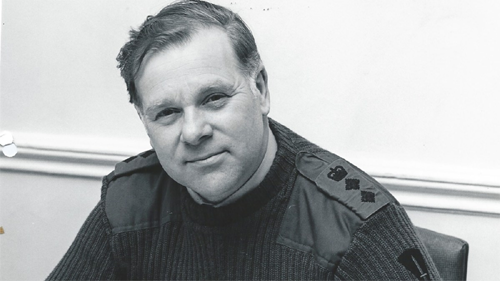
Ian Baxter was known for his tact and his keen eye for tactics
Ian Baxter was an enterprising and imaginative logistician who proved his worth in the Falklands War in 1982, a conflict for which no administrative preparations worthy of the name had been made. Accustomed to the unusual and unexpected, he rose to the challenges during the assembly of the task force, its transit to the South Atlantic, and support after the landing.
Twenty years earlier he had been ordered to postpone his honeymoon and report to Pembroke dock to bring two squadrons of German tanks ashore. Their mission was entirely peaceful — firing practice on Castlemartin ranges — but the dock had been heavily bombed by the Luftwaffe during the Second World War and there were locals who looked upon the grey, black-crossed monsters being transported through their streets on Baxter’s enormous transporters with decidedly mixed feelings. The German tank crews were grateful for his tactful handling of their entry to the UK and Baxter was invited to bring his bride to their introductory cocktail party.
He was quick to bring out the best in people through jokes and irony
Years later, following command of 2nd Armoured Division Transport Regiment in Germany, he was drawn into the Falklands War through his appointment as chief logistics officer of Major-General Jeremy Moore’s Commando Force, Royal Marines. He had passed the 12-week all-arms commando course at Lympstone in Devon at the age of 43 and is thought to be the oldest candidate to do so.
Six months into his new appointment he had made a comprehensive examination of the ammunition, fuel and supply scales calculated to be required by the Commando Brigade to mount and sustain operations overseas and judged them to be critically inadequate. Fortunately for the prospects of British arms in the South Atlantic, he had racked up substantial levels of the essential commodities by the time the task force sailed. Even so, many last-minute items had to be bundled aboard in an expedient manner rather than as they would be required for combat.
Relations with the defence ministry’s procurement department, which by reputation was a ponderous and not especially helpful body, proved excellent; for example, the acquisition of stocks of 105mm artillery airburst ammunition from Germany. Baxter perceived that high explosive rounds would have little impact on the soft ground of the Falklands, but airburst would be at a premium in defeating the Argentine infantry. He also arranged the supply from France of communication equipment to allow the Commando Brigade’s light helicopters to communicate directly with the ships of the task force.
The availability of Ascension Island proved a valuable bonus because it allowed Baxter to make two visits to influence the cross-loading of supplies between ships, which let him eliminate some of the more glaring faults of over-hasty loading. The loss of the Atlantic Conveyor with four Chinook and six Wessex helicopters aboard called for a comprehensive revision of his planning, which, although completed in record time, inevitably resulted in a “fingers-crossed” solution.
In a brief war, which is what the recovery of the Falklands became, the logistics battle must be won early and comprehensively. Baxter achieved that and was advanced to CBE from the MBE he received for service in Northern Ireland.
Ian Stuart Baxter was born in Bermondsey, the son of Charles Baxter, an artist and teacher, and his wife, Edith, in July 1937. He was educated at Ottershaw School, Surrey, and entered the army through a National Service commission. He married Megan (known as Meg) Bullock, a former journalist and later headmistress of Clewborough House School in Camberley, in 1961. They had three daughters: Deborah, who is in the antique business; Louise, who works in an art gallery; and Marianna, who is a ceramicist. His wife and daughters survive him.
His early military experience had led him to grapple with the difficult and unexpected. After welcoming the first German tanks to grind their way on to British soil, he went to Kenya to join a transport squadron, then on to Swaziland, a small landlocked country in southern Africa run by Britain for most of the 1960s, where civil unrest had broken out. He took 30 transport vehicles in support of 1st Battalion the Gordon Highlanders, who calmed down the situation. For their part, Baxter’s drivers were never without a football in their cabs, ready for a spontaneous kickabout with the locals.
His first experience on the staff was in Calcutta in charge of air movements for the 15,000-strong Gurkha force based in southeast Asia and their home country of Nepal. Negotiations with the Indian customs service taught him how to establish and maintain good relationships, exactly the requirement when, years later, he had to make difficult demands in 1982.
After staff college he became the chief logistics officer of 8th Infantry Brigade in Londonderry, but was responsible for the security of the whole province other than Belfast. In the aftermath of Bloody Sunday in January 1972, he was involved in dealing with owners of property requisitioned for units brought in as reinforcements, an increasingly sensitive business requiring tact and patience. His humorous and positive personality proved to be a great help in this as he was quick to bring out the best in people through a mixture of jokes and irony.
He became well known in the army and on promotion to brigadier after the Falklands War he was appointed director of army recruiting. This was regarded as a poisoned chalice, as economic prosperity and full employment led to recruitment problems. He embraced competitive advertising, visiting universities and schools to talk up the army as a career. He was particularly successful in overcoming prejudices against military service among ethnic minorities.
Promotion to major-general on appointment as assistant chief of defence staff (logistics) brought a slower-moving set of challenges and the frustrations of working in the MoD, with its constant battle between seemingly essential requirements and dwindling availability of funds.
When offered a second assignment in the ministry, he retired at his own request to open an antiques business in his home town of Callington in Cornwall — and to be able to cook breakfast for his family virtually every day rather than only at weekends.
Major-General Ian Baxter, CBE, soldier, was born on July 20, 1937. He died of cancer on October 17, 2017, aged 80